
Interdisciplinary work is multiplicative. By weaving together methodologies, resources, and intellectual traditions, researchers can arrive at insights that are greater than the sum of their academic parts—an approach well suited to the ever-increasing complexity of today’s world.
In an effort to highlight such scholarship and spark new collaborations, faculty from across the university came together on Feb. 25 for the Spring 2026 Organized Research and Creative Activities (ORCA) Symposium.
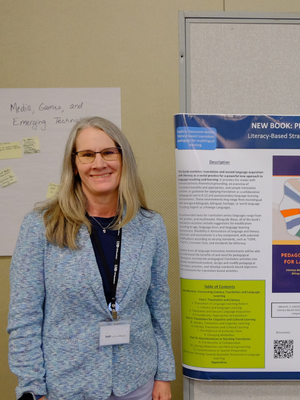
Hosted by the Office of Research and Sponsored Programs, the symposium provided faculty with an opportunity to share research, explore new ideas, and connect with colleagues across academic disciplines. Through roundtables and poster presentations, participants showcased work spanning fields such as literature, psychology, education, criminology, music, and emerging technologies.
The symposium also introduced the Team Research Incubator Program (TRIP), an initiative designed to support collaborative research among faculty. The program will accept funding applications from interdisciplinary teams to develop innovative research ideas. The proposals will be evaluated on the use of faculty expertise, innovation, potential for external funding, and the potential for publications, patents, or intellectual property.
You can view the full list of roundtable discussions and presentations below.
Roundtables:
Dr. Katharine Jager, “Vernacular Aesthetics in the Later Middle Ages: An Interdisciplinary Edited Volume”
Dr. Anthony Foster, “Understanding Associative Stigma: Avoidance Mediates the Relation Between Anticipated Stigma and Psychological Distress”
Dr. Ayden Adler, “”Classical” Music: Caste, Race, and High Culture in Boston”
Dr. Krista Gehring, “Criminological Understandings of Horror Films: Reel Fear”
Dr. Katrina Rufino, “The Association of Sleep Across Inpatient Treatment and Suicide Ideation, Attempt, & Death”
Dr. Rupak Rauniar, “A Triadic Model of Human, Emotional, and Artificial Intelligence for Customer Engagement during Service Encounters”
Dr. Su Jiang, “The Dual Development Process of Belongingness and Identity of First-Year Engineering Students”
Dr. Ethan Marshall, “Examining the Etiology of Hypersexuality Among Women with Histories of Sexual Abuse”
Denise Burgan & Dr. Jonathan Schwartz, “External Funding Opportunities for Research”
Dr. Lisa Jennings, ““A Floud of Poyson Horrible and Blacke”: Using Renaissance Alchemy to Understand Racial Blackness in Edmund Spenser’s Faerie Queene Epic (1596).
Poster Presentations:
Dr. Kit Cho, “Steering the Drifting Mind: Using Self-Testing to Improve Learning Among Bored, Multitasking Students”
Dr. Sarah Albrecht, “Pedagogical Translation for Language Teaching: Literacy-Based Strategies for Emergent Bilingual, Bilingual, and World Language Learners”
Dr. Yajaira Ceciliano- Navarro, “The Role of Parental Involvement in College Student Success”
Dr. Claude Rubinson, ““If I’m not me, then who the hell am I?” Exploitation of Mental Labor in Postmodern Science Fiction Films: A Structural Analysis of Narrative using Qualitative Comparative Analysis”
Dr. Travis Crone, “The Impact of Religious Identification and Narrative Perspective Taking on Empathy and Transprejudice”